

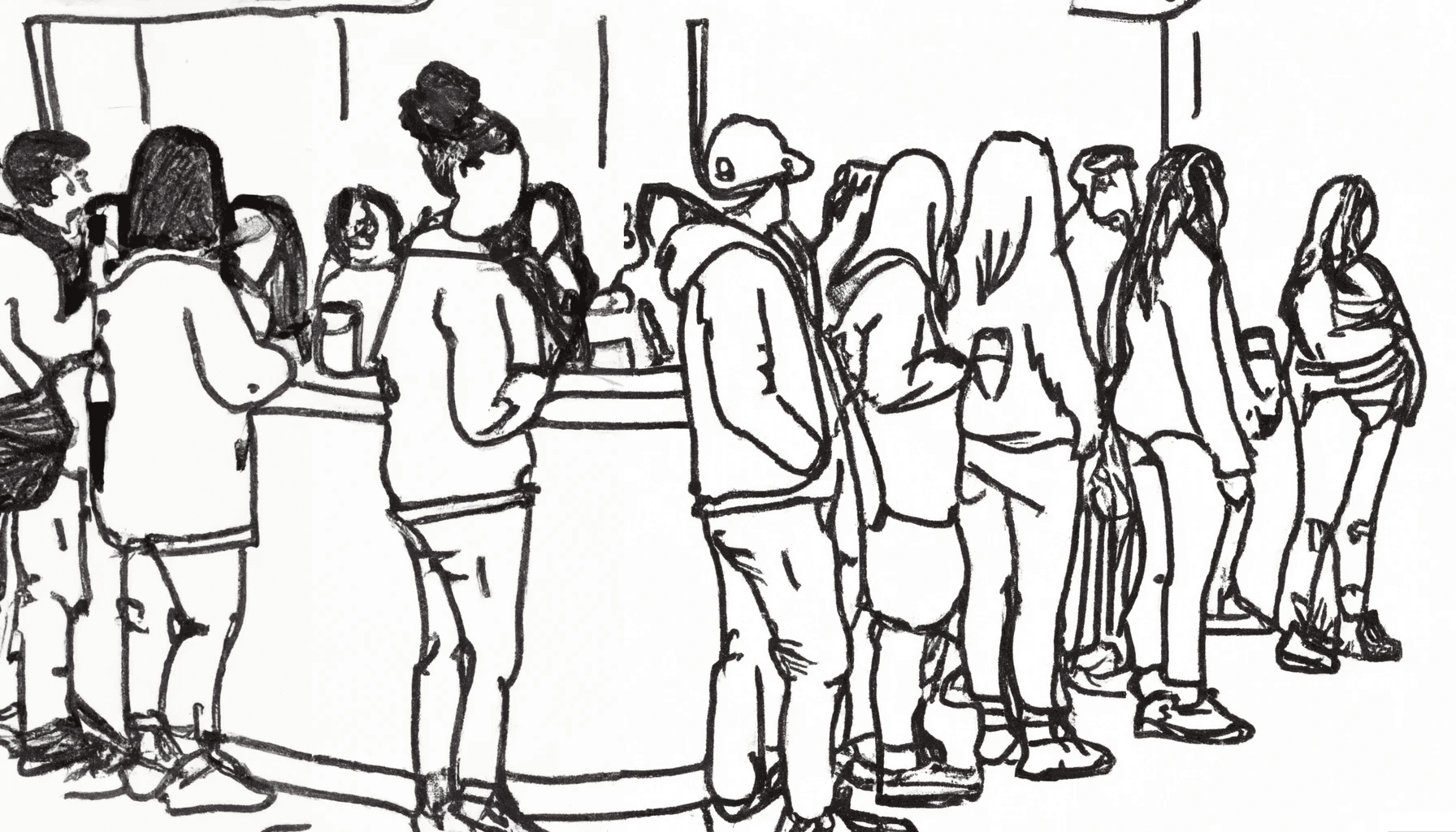
Over Christmas break I put out a Facebook post which proposed the following thought experiment:
How do you decide to run it? Do you:
A) Keep the line as short as you can, take as many orders as possible, and then allow people to sit down on your tables and couches to wait for their orders, or...
B) Let the line grow as long as it can, only taking new orders once old orders have been fulfilled?
By the way, this is not a question about profit vs customer experience tradeoffs. The correct answer makes you more money *and* makes your customers happier. The wrong answer makes you less money today, makes your customers mad, and hurts your repeat revenue (negative NPS score for this cohort of customers).
The Starbucks I just went to chose A. Were they correct?
I was pleased to see people opining in the comments. Apparently I am not the only one using my Christmas break on fun inanities! However, I was also very surprised to see how strongly the majority opinion tended toward method A. Here are the results by my count:
A: 9 votes. B: 3 votes
Method A won the popular vote by a margin of 25 points! That's ok. I knew that I was going to be the contrarian on this one.
The Option B Argument
There are two knobs which can be turned: profit and customer happiness. (I take Starbucks to be sufficiently standardized that drink quality is constant).
Let’s start with profit. Profit is Revenue - Expenses.
I actually think that the revenue is just about the same for both A and B. This is because revenue is determined by the bottleneck, which as far as I can tell is the espresso machine. Assuming you have saturated demand all day, you can roughly estimate the revenue by the following: [Flow rate of bottle neck] x [Time open] x [Average ticket size].
I don’t think that either A or B make the bottleneck flow any faster than the other. In both cases, as soon as the espresso machine is available, it will be immediately loaded again by an employee. If you’re curious to learn more about this phenomenon, I would suggest reading The Goal by Eli Goldratt. The underlying principle is called “the theory of constraints”, and it stipulates that no system can realize more total output than the output of its slowest bottleneck. The Goal is an extremely approachable exposition of the theory of constraints in the context of a well written narrative.
So, I think the top line revenue will be around the same in either case. In both A and B, the Starbucks will not be able to serve all the customers who wanted to get a drink; it will serve almost exactly [the flow rate (in customers)] x [amount of time open].
Now, two of my commenters were both concerned about losing customers due to a long line. And if I had to guess, I would say that was probably going through the head of the Starbucks manager as well. "I want to serve as many people as I can, and a long line will turn people away, right?"
But remember, the number of customers we can serve is fixed, and that fixed amount is significantly less than the number of people who wanted to buy from you today. Your long line may turn people away, but it will also stay long all day, which means you will still serve the same number of people.
So you will lose customers, the question is simply under what circumstances you will lose them.
I’ll have to ask you to hang on to the previous statement; it’s a good segue into the customer happiness aspect, but first I need to round out my argument for why B is more profitable by addressing the other part of the profit equation: Expenses.
I think you could actually pay one fewer person with method B and accomplish the same thing. The reason is that in method A, you need one person dedicated to the register at all times, since there is a steady yet sparse flow of people making orders. In B, you don’t need anyone dedicated to the register. Instead, you can use “dead time” while the espresso machine is not loadable to take new orders, in accordance with the cadence of customers at the end of the pipeline receiving their orders.
Anecdotally, I noticed that the 7 or 8 employees who were operating this Starbucks were always busy, but never moving fast. It felt like they were moving at half speed. I don’t blame them for this; they knew that if they rushed, they were just going to have to sit still and do nothing in a minute or so, because they were going to have to be waiting on the bottleneck nearest them. (More on this later in the customer happiness section.) However, you could not send these people home unless you committed to method B, because the peak amount of work at each station always added up to one whole person.
I think it’s possible they could have paid even fewer people and still served the same customers with the same quality. But I’m confident they could have done it with at least one less.
Ok, so much for profit. A day’s salary worth of gravy with method B.
But what about customer happiness? This one is even less intuitive, but in my mind, much more important. There are four reasons I believe that the customers would’ve been happier with method B, and lucky for you, I will touch on each.
Fences make good neighbors, gates make happy customers
A long line means that only the customers who are willing to a wait for a long time will engage with your company. Lines are an instant time-cost indicator for anyone considering whether or not to get Starbucks. If you’re on a tight schedule, a quick glance at the line will give you a good sense for how long you’ll have to wait.
This self-sorts people into those who feel that the coffee is worth the wait and those who don’t, without any real hard feelings. Very few people will feel personally offended at your long line. They might feel disappointed for a moment and skip coffee that day, but they will not harbor any ill will. (Remember, you don’t lose any money by people skipping coffee today; your market is saturated. This is just about which customers are being served, not how many).
It’s very unintuitive to look at a short line and a collection of people sitting around in chairs in order to get a sense of how much time you’re going to have to spend getting your drink. In our case, there was a very vocal minority of people sitting around who would certainly not have chosen to get Starbucks if they had really known the time cost.
Another way to say this is that the customer funnel was poorly gated. A customer gate is a subtle but vital mechanism in a business. It helps to ensure that you only do business with the right people, and that people who wouldn’t be great customers move on. Customer gates exist everywhere. Credit card companies gate their customers very explicitly. Credit scores and minimum income requirements are automated gates which help lenders numerically determine who they ought to do business with, saving them enormous amounts of money in the long run. But there are subtler versions of customer gates too, such as advertising, product design, and even the “vibe” of a place.
Once again, remember that you will turn customers away today; that’s just math. The important question is: what is the forcing function for turning customers away? In method B, it’s a long line, which is innocuous and in fact may actually make your company appear more valuable. Those who value their cuppa Joe highly will brave it, and those who value their time more highly will not. Unfortunately, in the case of this particular Starbucks, it was the scowls on the faces of the people waiting for their drinks. Prospective customers walked up and thought, oh, that is not a happy looking group of people. I think I’ll find my drink somewhere else. That's a worst-case scenario customer gate.
Lines are progress bars
Not only are lines a good way to make sure that only your dedicated customers get coffee from you today, a line also gives everyone who did choose to brave the wait a live progress bar on when they will receive the precious liquid. Nearly everyone in the unsatisfied blob had the same question on their mind: “When will my drink be ready??” There was even some contention between patrons, comparing their original place in line to the exact order that the drinks were coming out. A few ladies in particular seemed to have the entire original order in their head and were not happy when different drinks came out before others.
Even if you are not so petty as that, it is simply nicer from a psychological perspective to have a progress bar. You can decide whether or not to dive into an article you’ve been meaning to read if you can visually see how long the line is. Whenever the question, “how much longer” pops into your head, all you have to do is look up to get a satisfactory answer. “10 more people.” Compare this with the constant looking up, looking around aimlessly, trying to peer into the kitchen for a drink that kinda sorta looks like yours. (This is hopeless. They all look the same.)
Lines give customers an out
Method B gives people the opportunity to change their mind. If someone wasn’t paying attention and mistakenly decided to brave your line, Method B gives them an easy out: simply leave the line. The only thing they leave behind is the time spent in the line so far. Method A creates something much worse: a captive customer. The customer has already paid. If they walk away now, they leave their time and their $10 behind. I saw even worse versions of this in the blob: several people made and received phone calls while we were standing around in which they explained to the counterparty with colorful language the fact that they were trapped in this Starbucks because the incompetent staff was taking forever with their drink. Ouch! There’s no worse feeling than being a trapped customer in the hands of a big company. Those guys won’t be coming back, even on a good day.
Efficiency has superior optics
The crowd that was gathered around at the receiving end of the Starbucks was genuinely peeved at the behavior of the staff. It was clear that the staff were not rushing to get the orders done. I heard several mutterings of, “they need to get a pep in their step,” or, “wow, these guys need to find a sense of urgency.” For the reasons talked above, I don’t fault the staff at all for this apparent slowness. Since the bottleneck was saturated and there were too many employees present, the staff had to choose between moving at a steady, slower pace, or rushing around for a minute and then standing still for a minute. Optically, the second one would have been even worse.
Conclusion
Well, you thought it couldn’t be done, but here it is in front of you: a wild over-analysis of a Starbucks line on Christmas Eve. I hope you enjoyed it! I definitely enjoyed thinking through everyone's arguments. I also thought it was interesting that one of the B votes was my business partner Jonathan, who manages flow in a busy auto shop every day. He had this to say:
The shop that Jonathan manages has an NPS score of 80, so I will take that as an expert opinion!
-IT